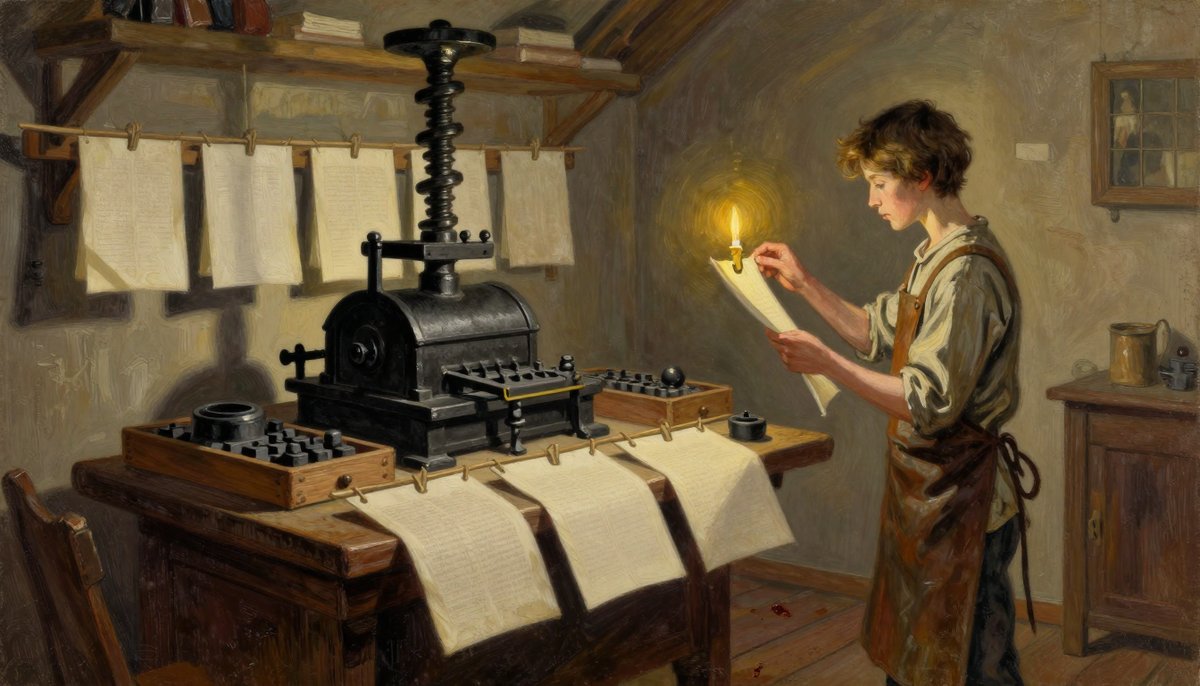
The press his father bought from a monastery, the shop his family used to own, and the boy who is neither its owner nor its apprentice but its property. He is checking an impression by candle. One of them is about to hum.
The patch
Rivensol, and the press in it. A walled city-state of half-timbered workshops and guild halls where magic is knowledge held in the mind — and holding it spends the mind that holds it. The guilds run on that scarcity: sworn oaths, licensed masters, chained ledgers. Kellen Weber is seventeen when we meet him, indentured into his own family's print shop after a noble house took it for a forged debt, scrubbing his father's ink stain out of the floorboards every evening.
Then a rune he cuts into a printing plate hums, and an impression comes off the press carrying the working. A page anybody can read does what a sworn master's memory used to do. Eight books run from there to a continental war, and the geography opens with them: one shop, then a city, then a federation, then a continent.
The set
- The Weber print shop — his father's press, his family's building, another man's property. Black iron and dark oak, taller than a man and twice as old, printing whatever the house that stole it says to print.
- The workshop in the tunnels — a small press hidden in the ancient undercroft beneath the city, reached through a passage nobody has mapped. Where the real work is done, and where the mentor is buried.
- The Beast Kin Quarter — the poorest wharves and tenements, worked by beast-kin and human labourers together and policed by neither guild nor crown. The first place the printed pages actually went.
- The guild halls — panelled oath chambers, chained ledgers, licensed masters. Not villains in cloaks — an institution doing exactly what it was built to do.
- The Federation capital — what the city becomes: a fragile guild democracy that has to survive its own founder walking away.
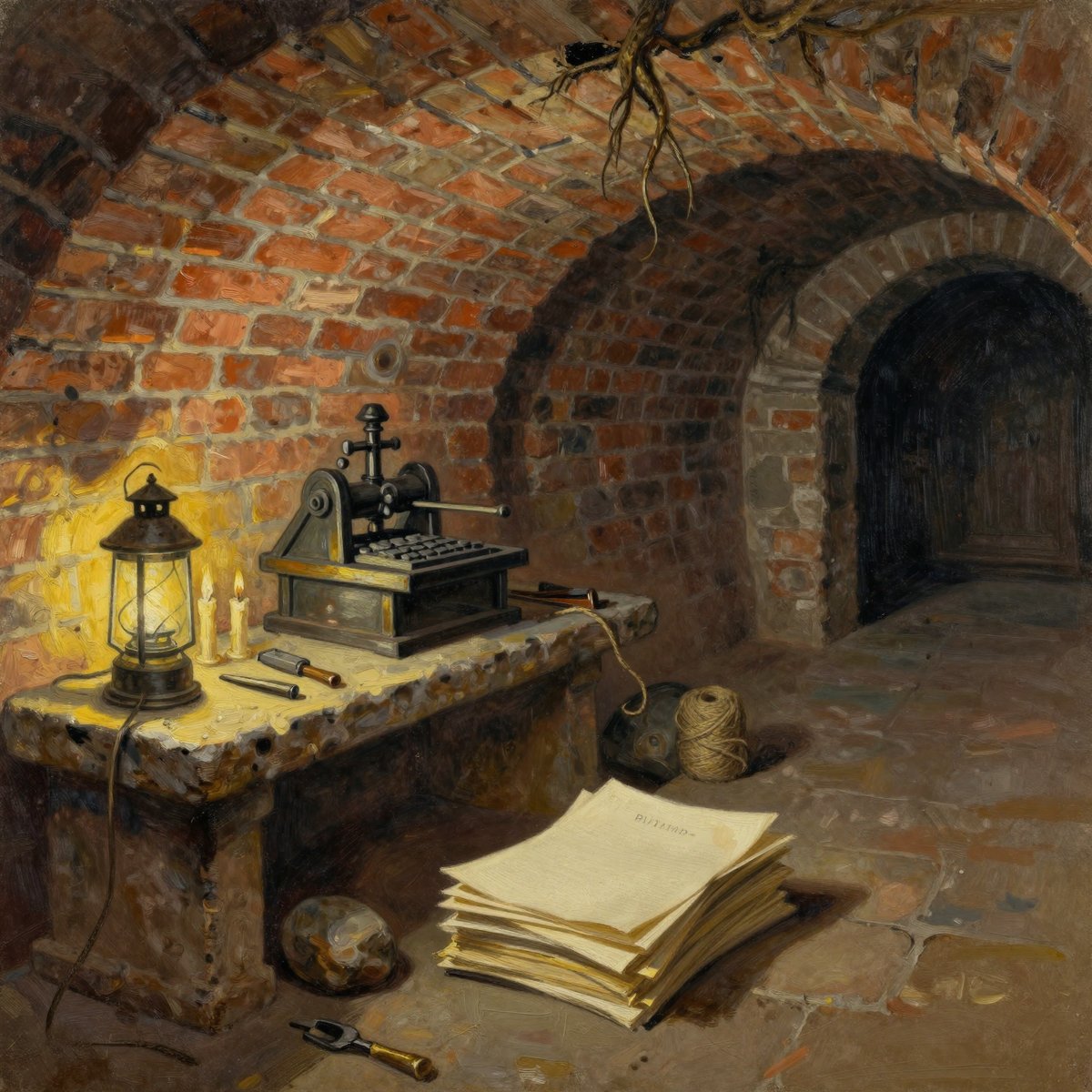
A small press wedged under a vault nobody has mapped, one hooded lantern, and a stack of paper weighted with a stone. Everything that matters in the first three books happens down here.
The cast
Told in one voice, Kellen's, and it does not spare him. In brief:
- Kellen Weber — seventeen at the start; long and thin with narrow shoulders that broaden across the series, brown hair past the collar, the indoor pallor of six years of lamplight and lead, ink permanently in the creases of his fingers. Unregistered and untrained, he holds everything in his own head — so the press that damns him is also the only thing keeping him whole.
- Sophie Dubois — a bookseller's daughter whose father was murdered for researching the same thing Kellen has just found. Mid-twenties, dark hair tied back, ink-stained hands, one dress worn for days at a stretch. His political partner first and for a long time; they marry in book seven.
- Hans — his oldest friend — beast-kin, half a head taller than Kellen and a handspan wider, silent on his feet, a coal-hauler's coat and a belt knife. He dies in book five, and the series never pretends to get over it.
- Master Aldric — sixty years at the press, grey-bearded, hands twisted by the work. An oath-bound guild printer who works out what Kellen is and shelters him anyway. He dies in book three and leaves a letter that says Finish it.
- Grimjaw — a massive furred and thick-knuckled dockworker with yellow rings in his eyes, grey at the temples, an old scar across the jaw and a dragged right heel. The last of the core allies to go, in book seven.
- House von Lusigned — the noble house that holds his indenture and, he is fairly sure, killed his parents. Behind them the Order of the Index, who ban dangerous books and hunt the people those books hollow out.
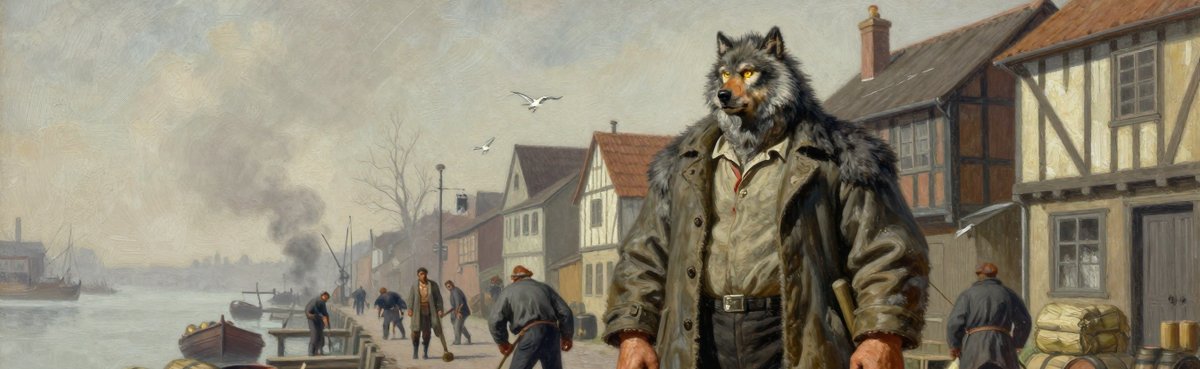
The wharves, worked by beast-kin and human labourers together and policed by neither guild nor crown. Grimjaw is on the boards with a bale hook. This is where the printed pages actually went first.
The rhythm
Not cozy, and not a power fantasy. It is an eight-book descent and return: discovery, then a movement, then a revolution, then the far harder work of proving the thing you built can stand without you. Named allies die, in order, and each death costs the reader something.
The magic is memory. Runes held in the head are fast and silent and quietly overwrite the person holding them; runes read off a page are reliable, slow, and leave a trace anyone can follow. No numbers, no levels, no game. And the political meaning is right there in the craft: when anyone can read the spell, nobody can own the magic.
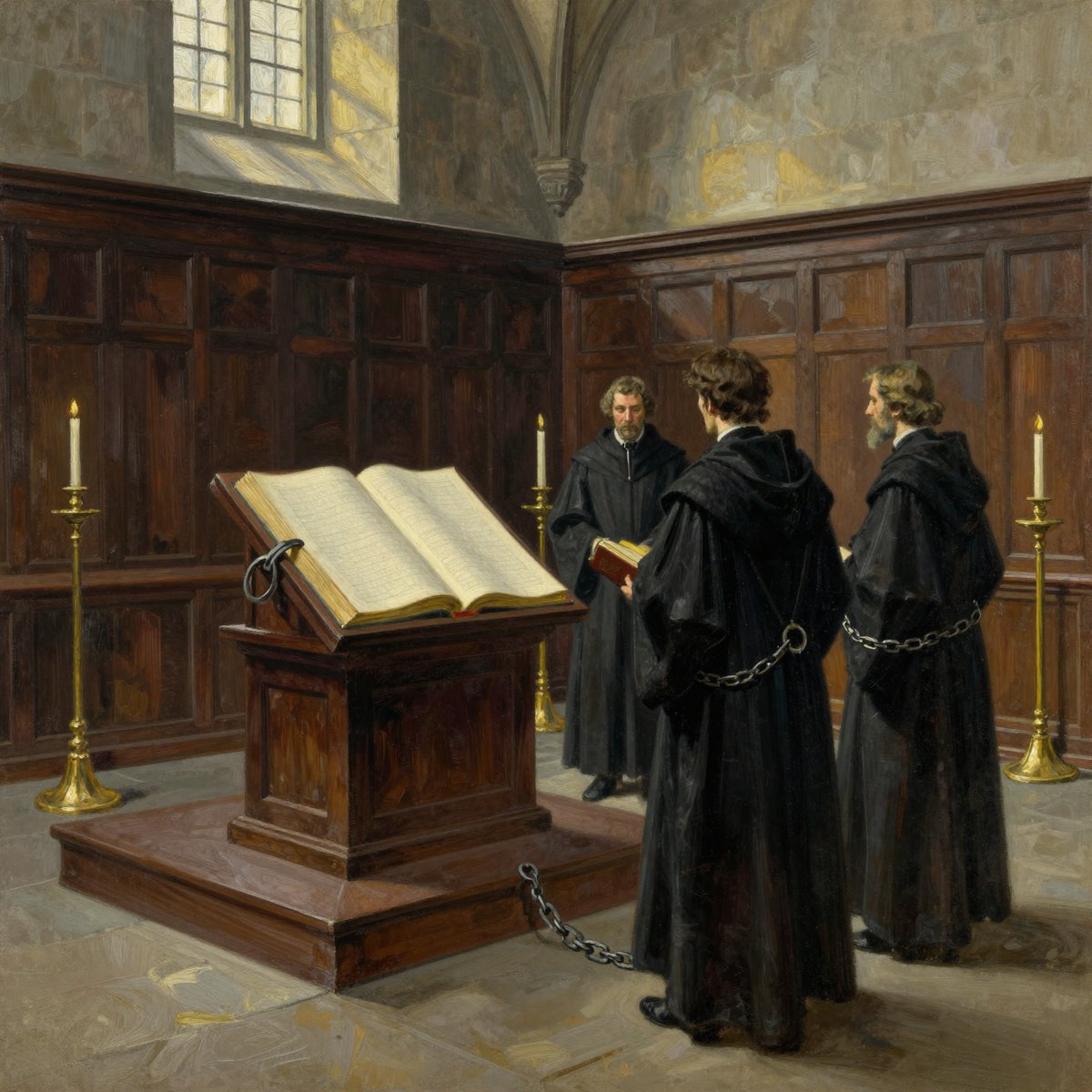
The ledger is enormous, and it is chained to the floor. Everything the guilds are is in that one detail: knowledge kept where it can be counted, and not carried out of the room.
The question the series asks
If knowledge is power, what happens to a world where power can be copied?
Where to start
One arc across eight books, in three movements — discovery, the movement, and proving it. Read them in order; the deaths and the politics both accumulate.
- The Apprentice — start here. Indentured in his own family's shop, Kellen finds his dead father's hidden plate and learns what the press can do. Every working is paid for, and he has not yet learned in what.
- The Journey — out of the city as a fugitive, and a first look at how far the oath system reaches. He comes back by choice.
- The Broken Indenture — the debt that ruined his family was forged. The mentor dies, and the letter says finish it.
- The Imperial Response — six regiments occupy the city, hunting one printer. The cost of every page he runs starts landing on people below him.
- The Revolutionary War — the rebellion he armed begins to win, and the guilds loose something that unmakes minds. The book the series is built around.
- Two Hundred and Fourteen Names — a four-century order answers with blockade and invasion. He is offered a crown, in effect, and what he does with the offer is the point.
- The Federation — the system tested without its founder. He has stepped back, married Sophie, and is trying to be nobody.
- The Knowledge — sixteen years on, a second great war, and a middle-aged printer who enlists as one anonymous man among millions. "I was just the printer. The knowledge was always yours."